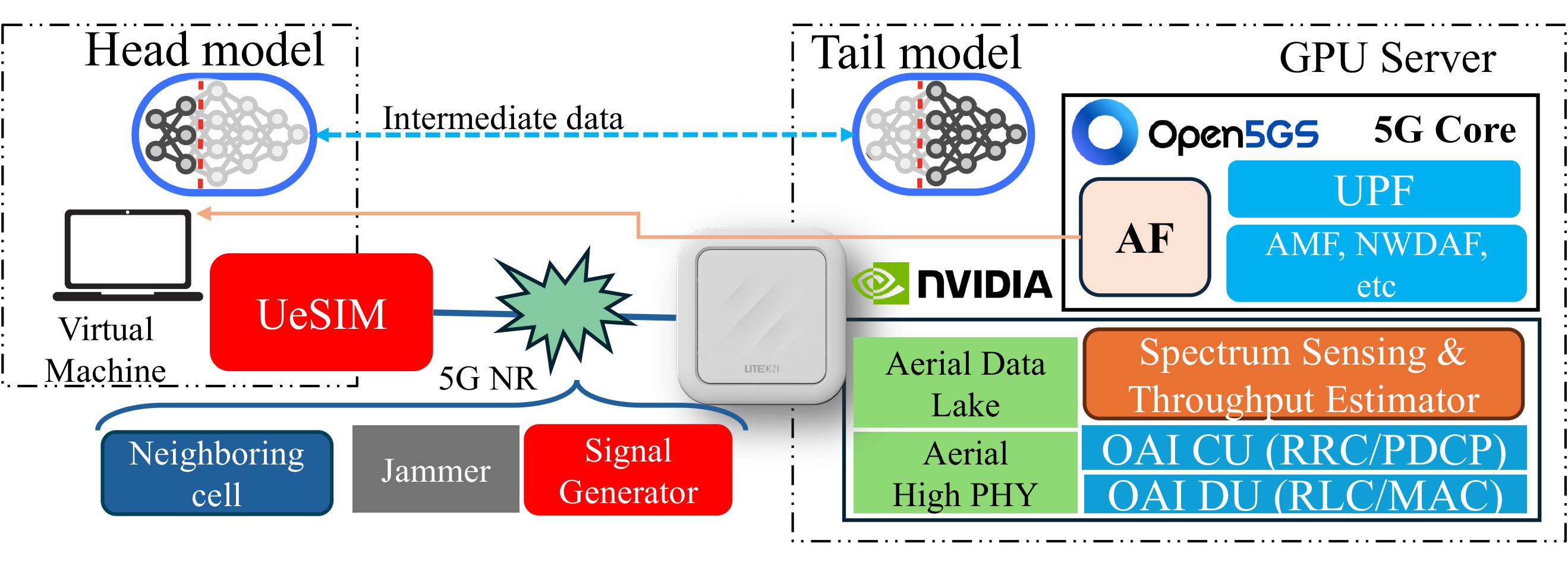
This dataset is collected from a live 5G NR testbed built on the NVIDIA Aerial CUDA-accelerated RAN. It includes both Layer-1 IQ samples and Layer-2/3 radio measurements under various interference conditions such as UE-to-BS co-channel interference, BS-to-BS TDD mismatch, and external jamming.
Uplink throughput was benchmarked using iPerf3 across high-load and low-load configurations.
Data Collection Methodology:
- Layer 1 I/Q Samples: Collected and pushed to ClickHouse database autonomously by cuBB
- Layer 2/3 Metrics: Collected using xApp monitoring script
xapp_mac_rlc_pdcp_gtp_moni.py - Architecture: xApp-based monitoring system using RIC (RAN Intelligent Controller)
- Data Storage: ClickHouse database for high-performance time-series data storage
- Collection Rate: 20 Hz (50ms intervals) for real-time monitoring
Layer 1 I/Q Samples:
- Collection Method: Automatically collected and pushed to ClickHouse by cuBB (NVIDIA CUDA-accelerated baseband)
- Baseband I/Q samples from the 5G NR air interface
- Time-frequency domain representations
Collected Metrics by Protocol Layer:
- Physical Layer: RSRP, SS-RSRP, SS-RSRQ, SS-SINR, CQI
- MAC Layer: BLER, HARQ retransmission statistics, MCS, PHR
- RLC Layer: Buffer status, PDU transmission metrics, retransmission statistics
- PDCP Layer: Buffer status, throughput measurements, sequence number tracking
- GTP Layer: Tunnel statistics, packet transmission rates, establishment events
Interference Scenarios:
- UE-to-BS Co-channel Interference: Multiple UEs operating on the same frequency
- BS-to-BS TDD Mismatch: Base station timing misalignment scenarios
- External Jamming: Intentional interference injection for robustness testing
The dataset is designed to support engineering and research tasks in:
- ML-based throughput estimation using combined I/Q and KPI features
- Adaptive model partitioning between UE and edge servers
- Performance analysis of 5G NR under controlled noise and interference scenarios
- Privacy-aware edge intelligence and resource optimization
The data is stored in ClickHouse with the following table structure:
- Layer 1 I/Q Samples: fapi , fh
- Layer 2/3 Metrics: MAC_KPIs_2, RLC_KPIs, PDCP_KPIs, GTP_KPIs
📄 Research Paper
Read our published research on adaptive AI model partitioning
PDF